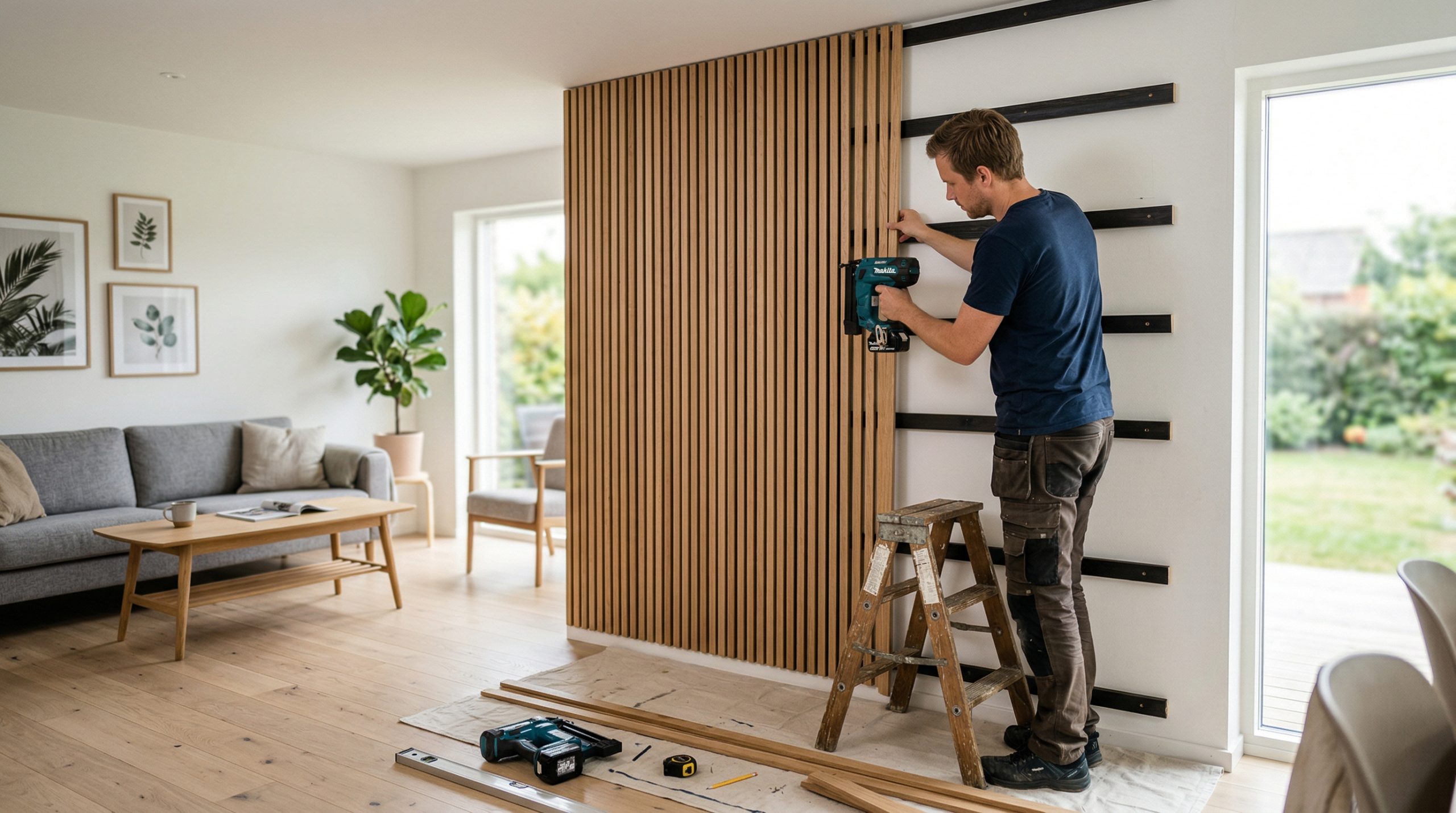
Building a slat wall yourself is a project many people can do successfully, as long as the planning is as careful as the installation. You do not need overly complicated solutions to get a polished result, but you should have control over measurements, substrate, material choice, and spacing before you begin.
Whether you want to use a slat wall as a room divider, TV wall, headboard, or patio screen, the basic principle is quite similar. This guide explains what to think about, which mistakes are most common, and how to build it step by step without overcomplicating the project.
What should you clarify before you begin?
Before you buy materials, decide what the slat wall is meant to do. Is it primarily decorative, meant to add privacy, divide a room, or create a bit of shelter outdoors? The answer affects height, width, material choice, and how close the slats should be.
It also helps to check the substrate carefully. Drywall, masonry, wood, and concrete do not always call for the same fixing method. If the slat wall will be freestanding, you also need to plan for stability at the floor and ceiling. If you are building outdoors, think more carefully about moisture, wood movement, and wind exposure.
What materials and tools do you need?
It is tempting to focus only on the slats, but the result is usually better when you think about the whole assembly first. You do not need the most expensive parts, but the pieces should fit together and suit the way the wall will be used.
- slats in the size and wood species you want
- battens or a supporting frame if the design needs it
- screws or other fasteners suited to the substrate
- saw, drill, level, tape measure, and pencil
- finish treatment if the wall will be exposed to weather or a more demanding environment
If you are unsure about finish choices, it can help to read more about finishing slat wall slats before you decide, especially if the project will sit in strong sun, shifting temperatures, or higher humidity.
How do you measure correctly before installation?
Good measuring saves a lot of frustration later. Measure the full surface in several places, not just one point. Walls, floors, and ceilings are rarely perfectly straight, and small variations become visible quickly once repeated slats are installed side by side.
Then decide on the slat width and the spacing you want. That decision affects both the look and how many slats you need to buy. If you want a lighter, more open expression, a more open setup can work well. If you want more screening, the spacing usually needs to be tighter. If the wall will be used outdoors, you may also find our guide to slat spacing on a patio useful.
Once you have a rough width and spacing in mind, it helps to calculate the overall layout before you buy materials. That shows you whether the solution works with the actual dimensions of the space.
How to build a slat wall step by step
The build itself does not need to be complicated, but the order matters. Working in the right sequence makes the result straighter, cleaner, and easier to adjust.
- Mark the outer edges. Define the exact start and end of the wall and make sure the first reference line is straight.
- Install battens or a frame if needed. This gives you a more reliable substrate and makes even fixing easier.
- Cut all slats as evenly as possible. Small differences become visible quickly, especially indoors.
- Use a spacer block or fixed template. This is the easiest way to keep the gaps consistent.
- Check your lines as you go. Do not wait until the end to discover the wall has drifted out of plumb or the spacing has changed.
- Apply finish where needed. Outdoor projects and some interior environments need more protection to stay looking good over time.
One useful trick is to dry-fit a few slats before you complete the whole wall. That lets you judge the width, spacing, and visual balance before all the material is committed.
What mistakes are most common?
The most common mistakes are rarely about sawing. They usually come from planning. Many people measure too loosely, choose the spacing without testing the visual result, or forget that wood can move when temperature and moisture change.
Another typical mistake is choosing the fixing method before thinking through the substrate. What works well on an interior timber wall is not always the right solution on masonry, in a bathroom, or on a patio. If you are unsure, it is better to spend extra time on the fixing details than to rebuild later.
When is it better to simplify or get help?
If the wall is large, freestanding, or needs to withstand significant weather and wear, it can make sense to simplify the project or bring in help for part of the job. That is also true if you want a very precise result on a highly visible wall in a living room or bedroom.
For smaller projects, though, it is often completely realistic to do the work yourself. Many people find that slat walls are ideal as staged projects, as long as they have a clear plan and know how many slats and how much material they really need.
Summary
Building a slat wall yourself becomes much easier when you first define the function, measure carefully, and choose a solution that suits both the substrate and the environment. The installation is often manageable. It is the planning that determines how smooth the project feels.
Before you start, it is worth testing a few combinations of slat width and spacing. That gives you better control over the final look and a more reliable material list. Use the calculator to estimate how many slats and how much total length you need before you order.