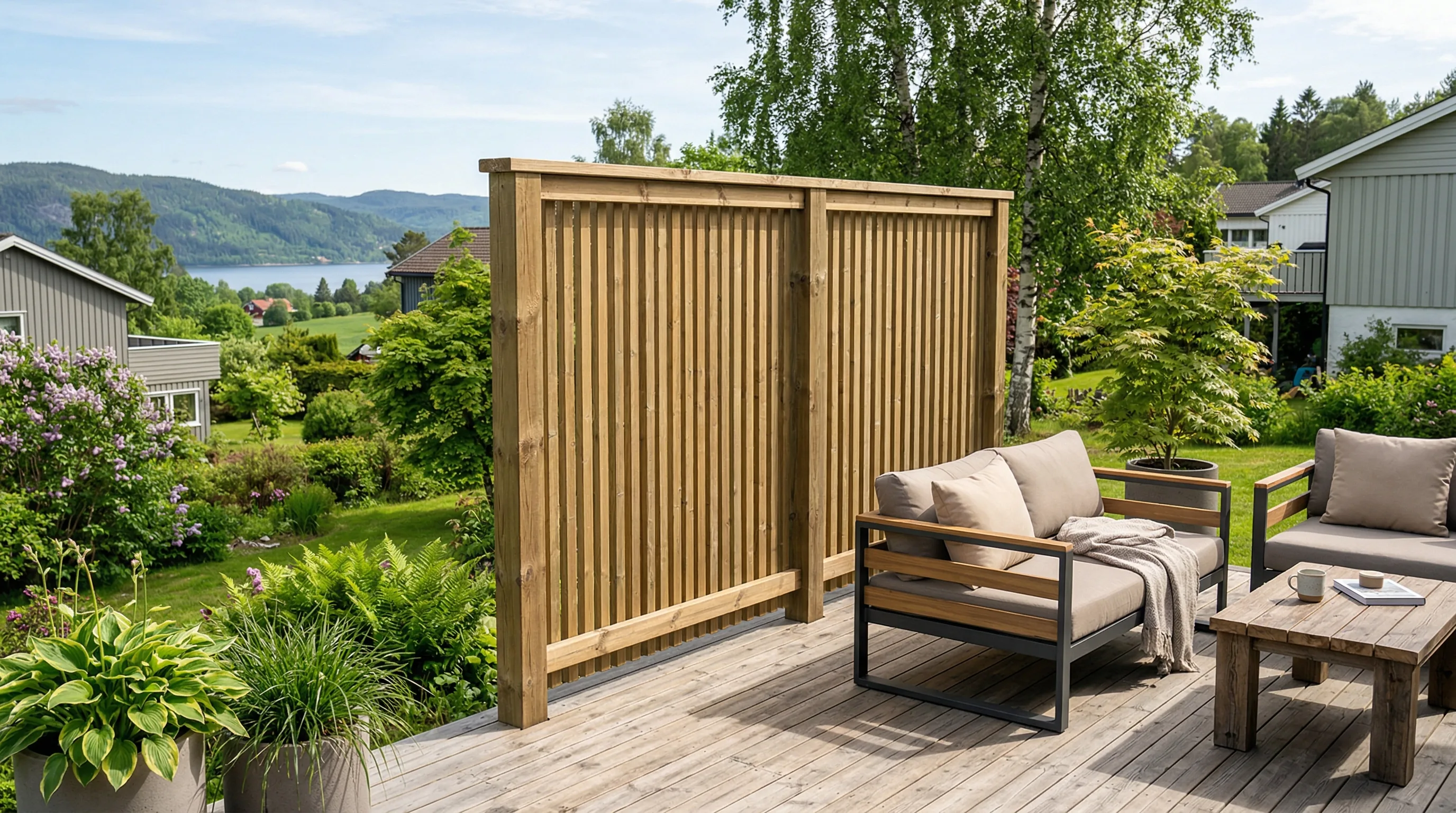
A freestanding slat wall stands on its own frame or base instead of being fixed to an exterior wall. It can screen, divide zones, or act as a room divider. The most important thing is stability: size posts and anchoring to the height, and use an open slat rhythm so the wall does not catch too much wind outdoors.
A freestanding slat wall is one of the most flexible ways to use slats. It can divide zones on a terrace, create lighter privacy screening in a garden, or act as a room divider indoors without making the space feel closed off. It also solves a practical problem many homeowners run into: you want screening or structure, but you do not want to attach anything directly to an exterior wall or build a full fence.
This is also a timely topic in spring. As outdoor projects start again in Norway, many people look for ways to make a terrace or seating area feel more sheltered before summer. A freestanding slat wall fits that need well because it can give privacy and definition while still letting through light and air.
What is a freestanding slat wall?
A freestanding slat wall is a slatted structure that stands on its own rather than being fixed across an existing wall surface. It may be anchored to posts, a base frame, planters, deck framing, or another structural support, but the visual impression is that the wall stands independently.
That makes it useful in several situations:
- when you want light screening on a terrace or patio
- when you want to divide one outdoor area into smaller zones
- when you need a room divider indoors without building a full partition wall
- when you want a decorative backdrop for seating, dining, or planting
The appeal is simple. A freestanding solution can look lighter than a solid screen, more architectural than a standard fence panel, and more adaptable than a wall-mounted slat feature.
When is a freestanding design the right choice?
A freestanding slat wall is usually the right choice when flexibility matters as much as appearance.
For example, it can work well if you want to:
- screen part of a terrace without blocking the whole edge
- create a more private corner for outdoor dining
- separate an entrance, lounge area, or hot tub zone
- add a soft room divider in an open-plan interior
- define a bed headboard wall or dressing area without full carpentry
It is often a better choice than a fixed wall when the area needs to stay visually open. Because the slats let some light and sightlines pass through, the result feels calmer and less heavy.
The trade-off is that a freestanding wall must be planned more carefully for stability. A decorative slat wall that looks light still catches wind outdoors, and a tall narrow divider indoors can feel flimsy if the base is too weak.
Start with function before dimensions
Before choosing slat width or wood type, decide what the wall needs to do.
Ask these questions first:
- Is the main goal privacy, wind filtering, zoning, or decoration?
- Will the wall stand indoors or outdoors?
- Will it be exposed to wind from one side or several directions?
- Should it feel open and airy, or more screened?
- Does it need to be permanent, movable, or easy to adapt later?
These answers shape nearly every design choice that follows. A freestanding wall meant only to mark a zone can stay lighter and more open. A wall meant to shield a seating area from neighbours or wind usually needs a stronger frame, smarter placement, and tighter slat spacing.
How big should a freestanding slat wall be?
Proportion matters more than people expect. Many DIY builds fail visually because the wall is either too short to do its job or too tall and narrow to feel stable.
As a general rule, think in terms of balance:
- lower walls work well for subtle zoning and visual structure
- medium-height walls suit terraces and seating areas best
- taller walls give more privacy but need better anchoring and heavier support
A very tall wall with a narrow footprint can quickly become top-heavy. Outdoors, that creates both a structural and visual problem. Indoors, it can still look awkward unless it is tied into floor and ceiling construction or built on a well-proportioned base.
If the wall is intended as a terrace screen, placement is often more important than maximum height. A screen positioned beside the seating area can feel more effective than a taller screen placed too far away.
Slat spacing changes how the wall works
Spacing is one of the most important decisions in any slat project.
Tighter spacing gives:
- more privacy
- stronger visual rhythm
- a more finished architectural look
Wider spacing gives:
- more daylight through the wall
- a lighter expression
- less visual weight
For freestanding walls, spacing also affects wind load. A completely dense-looking screen will behave more like a barrier, while a more open slatted wall can let some air pass through. That can be useful outdoors where the goal is softer screening rather than full enclosure.
The best choice depends on context. On a terrace, many homeowners prefer a middle ground that limits direct sightlines from the side but still keeps the area bright. Indoors, spacing is often chosen more for style and proportion than for privacy alone. For a fuller breakdown, read about typical spacing between slats.
What materials make the most sense?
For outdoor builds in Norway, material choice matters a lot because the wall will face moisture, seasonal changes, and possible freeze-thaw stress.
Pressure-treated timber is often the most practical starting point for a painted or stained outdoor project. It is widely available and suited to exterior use, but it still benefits from correct drying, finishing, and detailing.
Other options may include:
- thermally modified wood, when you want improved durability and a more refined finish
- durable exterior-grade softwood or hardwood, if budget allows and the design calls for it
- prefabricated slat panels, when installation speed matters more than full customization
For indoor walls, the range is broader. Solid wood, veneered battens, MDF-based systems, and acoustic slat panels may all be relevant depending on the look you want.
The key is to match the material to the environment. Do not use an interior slat product for an exterior freestanding wall just because the finish looks attractive online.
Stability is the real make-or-break issue
This is where a freestanding slat wall either becomes a satisfying project or a frustrating one.
The wall has to resist movement at the base, avoid twisting through the frame, and stay visually straight over time. Outdoors, wind is the biggest issue. Indoors, wobble and poor alignment are usually the biggest issues.
A stable build usually depends on a few core principles:
- posts or supports that are sized for the wall height
- a frame or fixing method that prevents racking
- anchoring that suits the surface below
- realistic expectations about how open or heavy the design can be
If the wall stands on a deck, think carefully about what the deck frame can actually support. If it stands on a hard surface, the connection details matter. If it is integrated with planters or benches, those elements must be heavy and solid enough to do real structural work, not just decorative work.
This is also the point where it makes sense to slow down and be honest about the build. A small interior divider is manageable for many DIYers. A taller exterior privacy screen may need more robust carpentry than the clean final look suggests.
Where should you place it?
Good placement solves more problems than extra material.
On a terrace, the best spot is often the side where people actually feel exposed, not necessarily the full outer edge. Screening one sightline well can improve comfort more than trying to wrap the whole space.
In a garden, a freestanding wall can help shape movement and create smaller outdoor rooms. It often works best when combined with planting, built-in seating, or a change in level.
Indoors, it can be used to:
- soften the transition between living and dining areas
- create a visual hallway in an open-plan space
- frame a bed or home office corner
- add warmth to a large blank room
Wherever you place it, think about what the wall looks like from both sides. A freestanding feature is almost always seen from more than one angle, so the back should feel as intentional as the front.
What should you check before building outdoors?
Even if the wall feels decorative, it may still function like a privacy screen or light wind screen. That means you should check placement, height, and any local restrictions before building, especially if the wall will sit close to a boundary, entrance, or shared outdoor area. The rules on height and length are covered in the guide on a slat wall privacy screen.
You should also think about:
- drainage around the base
- splash water from decking or paving
- how the timber will dry after rain
- whether the wall blocks sun at the wrong time of day
- how maintenance will be done once it is installed
A freestanding wall usually lasts longer when the design allows water to move away easily and avoids trapping moisture near end grain or fixings.
Common mistakes to avoid
Most problems come from rushing the planning stage.
The most common mistakes are:
- choosing proportions that look elegant in a photo but are too weak in real life
- making the wall taller before improving the support system
- using outdoor spacing rules indoors, or indoor aesthetics outdoors, without adjusting for function
- forgetting that a freestanding wall must look good from both sides
- treating the slats as the structure, when the hidden support is what really matters
If you avoid those mistakes, the finished wall is much more likely to feel intentional and durable.
Final thoughts
A freestanding slat wall can be one of the smartest slat projects for both homes and terraces. It gives you privacy, rhythm, and zoning without the heaviness of a full wall, and it adapts well to both indoor and outdoor spaces.
The best results come from keeping the project practical. Start with function, decide how open the wall should feel, choose materials that suit the environment, and put most of your planning effort into stability and placement.
If those decisions are right, the finished wall usually looks cleaner, works better, and lasts longer. Before you order, use the slat wall calculator to estimate how many slats and how many linear metres you need, and review the common mistakes to avoid when installing a slat wall.
Frequently asked questions
How tall can a freestanding slat wall be?
Indoors, the height is mostly governed by proportion and anchoring. Outdoors, the wall can function as a privacy screen, and then separate rules apply, often a maximum of 1.8 metres in height. Check the rules in the guide on a slat wall privacy screen.
How many slats do I need per metre?
With 48 mm slats and an 18 mm gap, each slat covers 66 mm, which gives around 15 slats per metre of wall width. Narrower slats give you more and a tighter look.
How do I make a freestanding slat wall stable?
Size the posts and anchoring to the height, build a frame that prevents twisting, and keep the slat rhythm open enough to let some wind through outdoors. A heavy, solid base is often more important than the slats themselves.