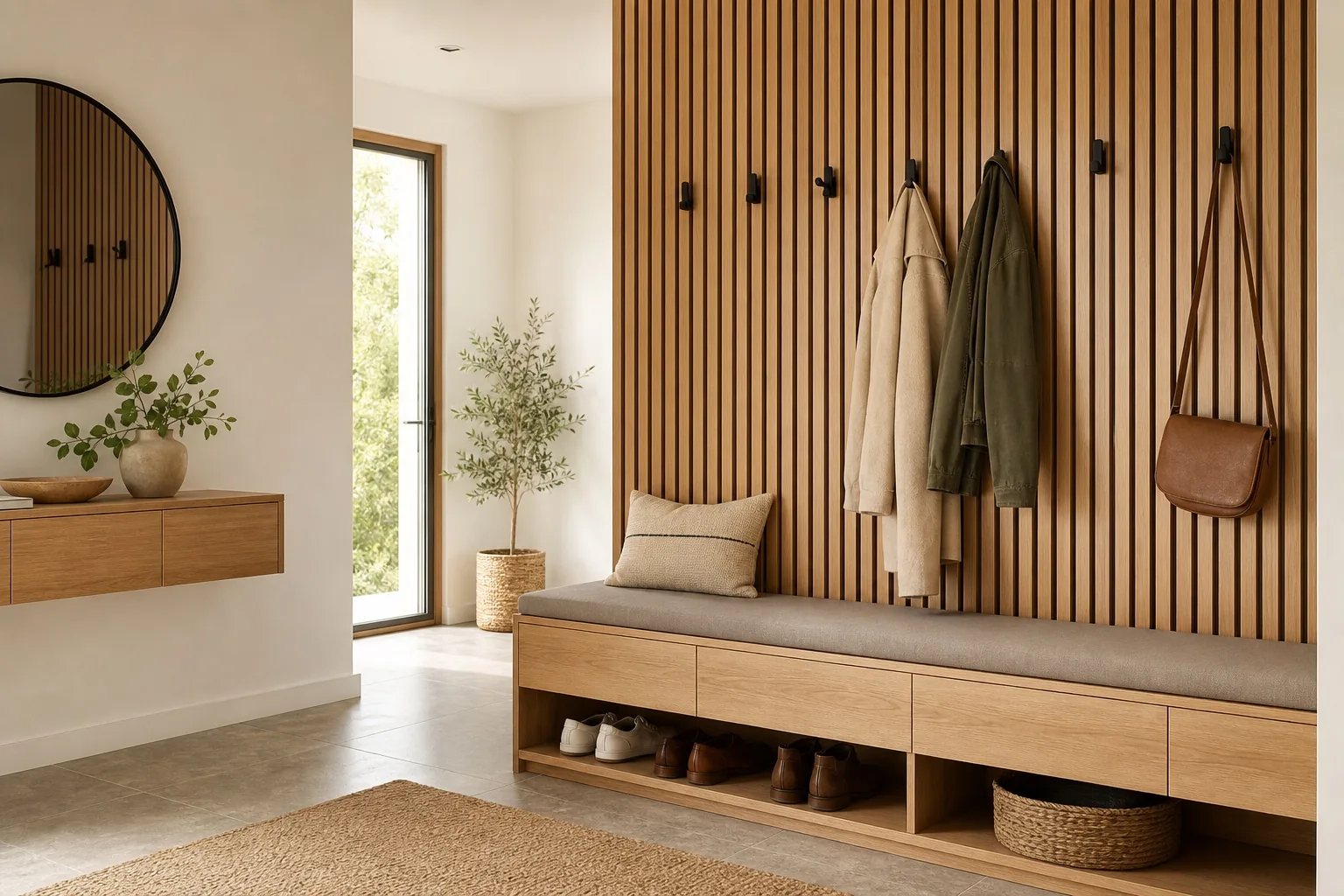
An entryway slat wall should be planned as a working wall. Anchor hooks into a stable backing board, battens, or studs, not just the slats, since coats and bags create point loads. Choose a durable finish that handles wet coats and hands, and keep the slats clear of floor moisture with a plinth or trim.
An entryway slat wall can do more than make the first space in the home look warmer. It can gather hooks, a bench, shoes, bags, and small everyday items into one calm zone.
It is also one of the hardest-working places for a slat wall. Wet coats, school bags, shoes, keys, and quick daily movement create more wear than a quiet living room wall. Plan the fixings, finish, and storage before you settle on the final slat rhythm.
Start With What The Entryway Needs To Solve
Think of the slat wall as a small furniture wall, not just decorative paneling. It may need to hold coats, bags, backpacks, keys, scarves, bike helmets, and wet footwear. When you start with function, it becomes easier to decide how large the slatted area should be.
List what needs a place:
- fixed hooks for coats and bags
- lower hooks for children
- a bench for putting on shoes
- shoe shelves, drawers, or baskets below the bench
- a mirror, key shelf, or small landing surface
- room for boots, wet shoes, and a floor mat
In a narrow entryway, a precise slatted section is often better than covering the entire wall with extra depth. You get the function without making the space feel tighter.
Fix Hooks Into The Structure, Not Just The Slats
Hooks create point loads. One winter coat is rarely the problem, but several coats, a heavy bag, or a child pulling on a hook can load the wall more than expected. Hooks should be anchored into a stable backing board, battens, or studs, not only into thin decorative slats.
A good approach is to install a solid backing board or horizontal reinforcement behind the slat layer where the hooks will sit. Then the screws can pass through the slats and into something that actually carries the load. If the wall is drywall, plan this especially carefully. Read the guide to installing a slat wall on drywall before choosing the fixing method.
You can use individual hooks or a concealed hook rail. A continuous rail can spread the load more evenly, while individual hooks feel lighter and more furniture-like. Either way, decide the fixing points before calculating exact slat spacing.
Let The Bench Define Height And Depth
The bench dimensions shape how the whole entryway works. A seat height around 17-19 inches suits many adults, but adjust it for the people who use it most. Depth should be generous enough for sitting, but not so deep that the walkway becomes tight.
In small entryways, a bench around 12-15 inches deep may be enough. With more room, 16-18 inches often feels more comfortable. Remember that open shoe shelves, baskets, and drawers need practical clearance. Winter boots need more height than low sneakers.
Plan the transition between bench and slat wall carefully. If the bench sits tight against the slats, the finish needs to tolerate contact from coats, buttons, and bags. If the bench is freestanding, starting the slats a few inches above it can make the wall feel lighter.
Choose Slat Width And Spacing For A Busy Zone
In an entryway, the rhythm should be calm enough to handle many details. Hooks, clothing, mirrors, and shoes already add visual activity. A very open slat wall can therefore feel busier here than it would in a living room.
As a practical starting point, slats around 1 1/4-1 3/4 inches wide with 3/8-3/4 inch gaps work well. Narrower gaps feel more integrated and furniture-like, while wider gaps make the wall lighter. If hooks will fasten through specific slats, make sure those slats are wide enough for the hardware to look intentional and secure.
Use the slat wall calculator before buying materials. Enter the wall width, slat width, and preferred gap, then check that the rhythm ends neatly at the door casing, corner, mirror, or closet. In an entryway, people stand close to the wall, so awkward end pieces are easy to notice.
Choose A Finish That Handles Wet Coats And Hands
An entryway is a high-touch zone. Untreated pale wood can mark quickly, especially where hands, wet coats, and bags hit the same area every day. Choose a finish that matches the use.
Matte lacquer often gives a good balance between natural wood feel and easy cleaning. Oil can look warm and alive, but it needs more maintenance. Painted MDF can work well if you want a calm color surface, but edges and corners should be durable.
Think about moisture from the floor too. The slats should not sit unprotected in a wet shoe zone. Leave a small gap above the floor, use a plinth, or finish against trim that can handle cleaning.
Resolve The Details Before Installation
Small details often decide whether an entryway feels built-in or improvised. Mark doors, trim, switches, outlets, and mirrors on the drawing before you start.
Check especially:
- whether doors or closet fronts can hit the hooks
- whether switches land neatly between slats or need visual adjustment
- how the slat wall ends at baseboards and door casing
- whether the mirror needs its own reinforcement behind the wall
- where wet shoes will sit without damaging the wood
If you use acoustic felt or a dark backing board, think about cleaning as well. Entryways collect dust and grit faster than many other rooms.
A Good Entryway Wall Is Calm And Robust
The best entryway slat wall looks calm, but it is planned like a working piece of furniture. Hooks need solid support, the bench needs the right dimensions, and the wood needs a finish that can handle daily life.
Once you know what the wall must carry and how storage should work, you can fine-tune slat width, gaps, and edge details. The result is an entryway that makes a good first impression and stays easier to live with. For more ideas on how slat walls work in different rooms, see the guide to slat walls in living rooms, bedrooms, and hallways.
Frequently asked questions
How do I fix hooks safely into a slat wall?
Anchor the hooks into a solid backing board, battens, or studs behind the slat layer, not just into the decorative slats. The screws can then pass through the slat and into something that actually carries the point load from coats and bags.
How many slats do I need for an entryway wall?
Use wall width ÷ (slat width + gap). On a 240 cm wall with 48 mm slats and an 18 mm gap that is 2400 ÷ 66 ≈ 36.4, so round up to 37 slats, roughly 97.7 linear metres once you add 10% for waste.
Which finish handles a busy entryway best?
Matte lacquer usually gives a good balance between a natural wood feel and easy cleaning. Oil gives a warm surface but needs more maintenance, and painted MDF can work if the corners and edges are durable enough to take knocks.