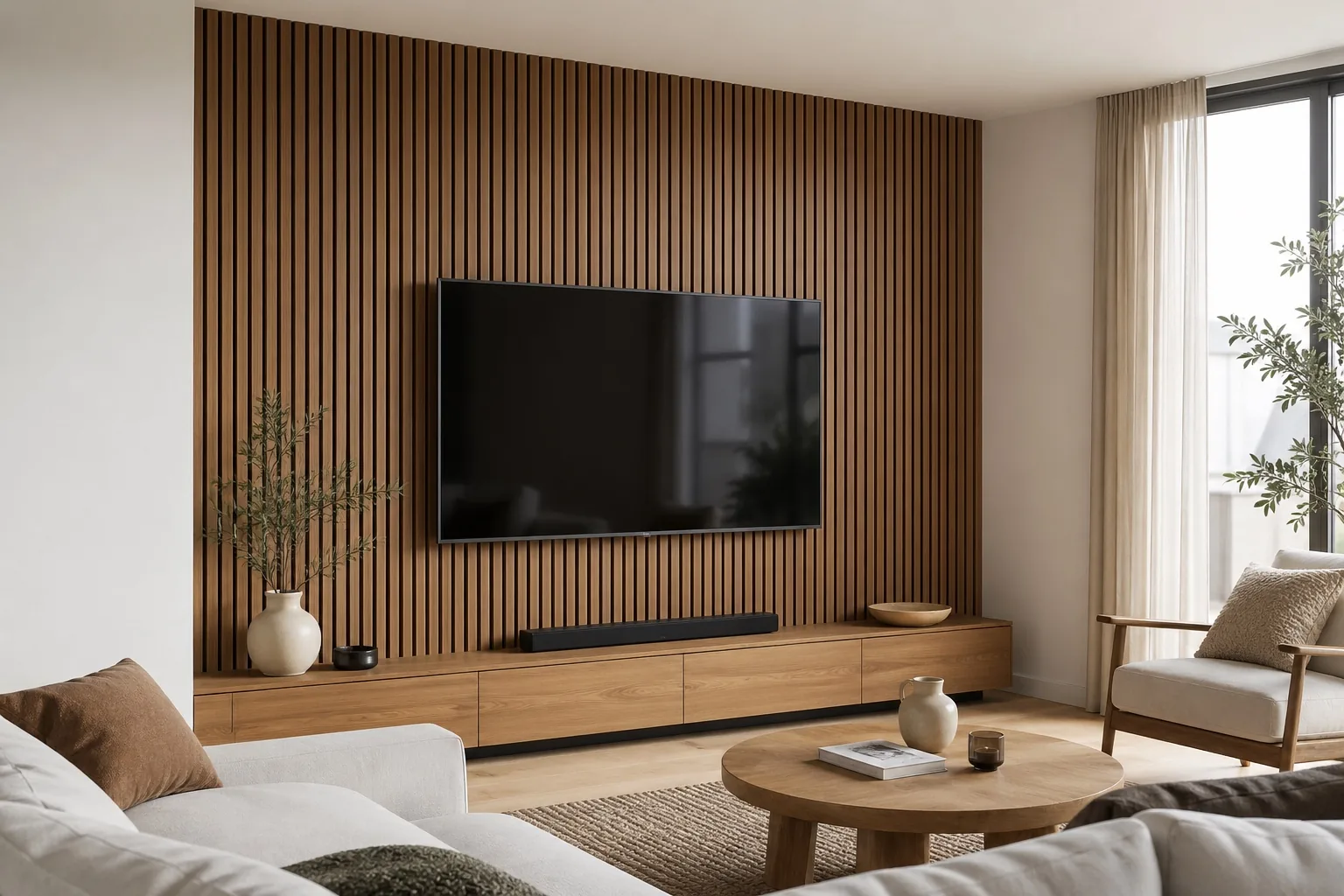
The best way to plan a slat wall behind a TV is to start with the technical side: a stable backing board or battens for the TV mount, tidy cable routing in conduit, and airflow around the electronics. Then choose slat width and rhythm to suit the screen size, and test the slat count in the calculator so the field ends neatly at trim and corners.
A slat wall behind a TV can make a living room feel calmer, warmer, and more intentional. The dark screen gets a proper backdrop, cables can be hidden more neatly, and the wall feels more finished than a plain painted surface. It is also one of the places where planning matters most.
The TV needs solid support, electronics need airflow, and you still need access to cables, outlets, and media devices after the wall is finished. Start with function before you settle on the look.
Map what the TV wall needs to hold
Sketch the full wall before calculating slats. Mark the TV, soundbar, media console, outlets, network point, and any speakers. Also think about the sofa position. A TV wall should not only look good close up, it needs to work from the main viewing position.
Check especially:
- whether the TV will mount to the slats, a backing board, or the structural wall behind
- where cables will run down to a media console or hidden equipment area
- whether devices need visible space or can be concealed
- where you will need access if something has to be replaced later
In many projects, the cleanest solution is to install a stable backing board or battens first, then use the slats as the visible layer. That gives the TV mount proper support while keeping the surface precise.
Let the screen guide width and spacing
Slat width should be considered together with the TV size. A large screen can usually handle slightly wider slats and a stronger rhythm, while a smaller TV often looks calmer with slimmer slats and lower contrast.
As a practical starting point, slats around 48 mm wide with 18 mm gaps work well in many living rooms. Slat width is usually in the 20-50 mm range and the gap in the 10-30 mm range. Narrower gaps feel more furniture-like and settled. Wider gaps make the wall lighter, but they can draw more attention to the backdrop when the TV is off. To understand how this affects the look, read more about typical spacing between slats.
Use the slat wall calculator early. Enter the wall width, slat width, and preferred gap, then adjust until the rhythm ends neatly at the side wall, trim, or opening. If the last slat becomes awkwardly narrow, a small spacing adjustment is often better than forcing the layout.
Plan cable routing before installation
Cable routing often separates a calm TV wall from one that looks improvised. Decide where cables should exit behind the TV and where they should end. Use conduit or cable channels where possible, especially if you want the option to pull new cables later.
Avoid burying loose extension cords or power strips behind a closed surface. Use proper outlets and installation methods suitable for your home. If electrical work is involved, confirm placement with a qualified electrician before closing the wall.
For HDMI, network, and speaker cables, it is wise to allow a little extra capacity. An empty conduit can be surprisingly useful when the TV, soundbar, or console changes later.
Keep airflow and service in mind
A slatted TV wall can become too enclosed if everything is built in tightly. Electronics, power supplies, and media boxes need air around them. If you use a low console, make sure it has enough openings or ventilation slots so equipment does not overheat.
Access matters too. A wall that looks perfect on day one can become frustrating if a cable swap requires removing slats. Consider one of these approaches:
- a media console with easy rear or top access
- a removable panel behind the TV
- a cable exit hidden by the screen but not permanently sealed
- equipment gathered in a ventilated cabinet
Match the feature wall to the room
You do not always need to cover the entire wall. A slatted field that is slightly wider than the TV and console can be enough to define the zone. In small living rooms, a framed section may feel lighter than full wall coverage. In larger rooms, full height and full width can feel more architectural.
Let the console, screen, and slatted area relate to one another. If the console is 8 feet wide, the slatted field might match it, extend beyond it, or run from corner to corner. The important thing is that the decision feels deliberate.
Choose a finish that works with screen glare
A TV wall does not take the same abuse as an entryway, but it still collects dust and often gets touched around the console and cables. Oak, ash, walnut, veneered MDF, and painted MDF can all work, but they create different moods.
Choose a matte finish if you want to reduce reflections from the screen. High-gloss lacquer can feel busy in a TV zone, especially with windows or lamps nearby. Dark felt or a dark backing board between the slats can add depth and reduce visual noise.
The best TV wall starts before the first slat
A good slat wall behind a TV is more than a decorative backdrop. It is a small technical wall with visible material, hidden routing, and practical access. When cables, mounting, airflow, and spacing are planned first, the finished result feels calmer and lasts longer.
Use the slat wall calculator to test slat count and spacing early, but lock the final layout only once you know where the TV mount, outlets, and cable paths will sit. That is how you get a wall that looks precise and is easy to live with. If you want to add mood lighting, you will find advice in the guide to a slat wall with LED lighting.
Frequently asked questions
How many slats do I need behind the TV?
Work it out with wall width ÷ (slat width + gap). On a 240 cm field with 48 mm slats and an 18 mm gap that is 2400 ÷ 66 ≈ 36.4, so round up to 37 slats. With 10% added for waste that is roughly 97.7 linear metres.
Can I mount the TV straight onto the slats?
It is not recommended. Anchor the TV mount into a stable backing board, battens, or the structural wall, and let the slats be the visible layer. That keeps both the fixing secure and the look calm.
What gap should I use between the slats behind a TV?
An 18 mm gap with 48 mm slats gives a calm, furniture-like look that suits many living rooms. Adjust the gap by a few millimetres so the last slat does not end up very narrow against the side wall or trim.